
Calculating PVC coating thickness in the extrusion process is achieved by balancing the extruder's material output rate (volumetric flow) with the production line speed and the desired cross-sectional area of the coating. The fundamental formula involves determining the required annular cross-sectional area of the plastic and using the line speed to calculate the necessary material volume per unit of time, which is then set on the extruder. This critical calculation ensures product quality, material efficiency, and adherence to industry standards. Whether you are coating wire, cable, pipe, or profiles, mastering this calculation is essential for operational excellence and profitability. A precise coating thickness guarantees the product's mechanical strength, electrical insulation properties, and longevity, while preventing costly material waste or product failures.
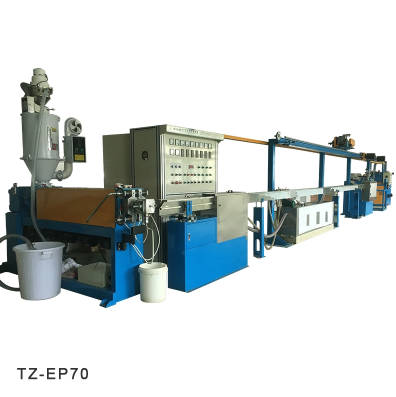
Foundational Principles: Understanding the Core Concepts
Before diving into the formulas, it's crucial to understand the two core principles that govern the extrusion coating process: volumetric flow rate and the draw down ratio. These concepts form the bedrock of any thickness calculation and provide the "why" behind the process adjustments you'll make on the production floor. Getting a firm grasp of these ideas transforms the calculation from a mere mathematical exercise into an intuitive understanding of the plastic's behavior.
What Is Volumetric Flow Rate?
The volumetric flow rate (Q) represents the volume of molten PVC that the extruder pushes through the die per unit of time. It's the heart of the entire process. This rate is primarily controlled by the screw speed (RPM) of the extruder. A faster screw speed generally results in a higher output, assuming consistent material feed and melt characteristics. The goal is to perfectly match this output volume to the volume required by the moving product (the core or substrate) to achieve the target thickness. If the flow rate is too high for the line speed, the coating will be too thick. If it's too low, the coating will be too thin. Therefore, accurately determining and controlling the volumetric flow rate is the first step toward precise thickness control.
Why Is the Draw Down Ratio (DDR) Significant?
The Draw Down Ratio (DDR) is a critical parameter that describes the degree of stretching the molten plastic undergoes after it exits the die and before it solidifies on the substrate. It is defined as the ratio of the cross-sectional area of the molten plastic at the die exit to the cross-sectional area of the final, solid coating on the product.
DDR = (Cross-Sectional Area of Die Opening) / (Cross-Sectional Area of Final Coating)
A higher DDR means the material is being stretched more, which can affect molecular orientation, internal stresses, and the final physical properties of the coating. For wire and cable coating, this is often discussed in terms of Draw Ratio Balance (DRB), which compares the draw-down inside the die to the draw-down outside the die. Managing DDR is essential for process stability. An excessively high DDR can lead to melt fracture or breaks, while a very low DDR might result in poor surface finish or sagging. A typical DDR in extrusion coating is carefully selected to balance production speed with material stability.
How to Calculate PVC Coating Thickness: Two Primary Methods
With the foundational principles understood, we can explore the practical methods for calculating coating thickness. These methods range from theoretical, pre-production calculations used for setup, to empirical, post-extrusion checks used for verification.
Method 1: The Theoretical Calculation (Pre-Extrusion Formula)
This method is used to set up the extrusion line before a production run. It calculates the required wall thickness based on the known dimensions of the core material (e.g., a wire's diameter) and the desired final outer diameter. The core of this calculation is determining the annular cross-sectional area (A_coating) of the PVC layer.
The formula for the final wall thickness of a coated wire is derived from the area calculation:
Thickness (t) = [ Outer Diameter (OD) - Inner Diameter (ID) ] / 2
To relate this to the process parameters, we use the principle of mass conservation. The volume of material extruded per minute must equal the volume of coating applied to the product per minute.
Volumetric Flow Rate (Q) = Coating Area (A_coating) * Line Speed (V_line)
From this, you can determine the required settings. For example, to find the necessary volumetric flow rate for a desired thickness:
1. Calculate the target Outer Diameter (OD): OD = Conductor Diameter + 2 * Desired Thickness
2. Calculate the cross-sectional area of the coating: A_coating = π/4 * (OD² - Conductor Diameter²)
3. Calculate the required volumetric flow rate: Q = A_coating * Line Speed
You would then adjust the extruder's screw speed to achieve this calculated volumetric flow rate (Q).
| Variable | Symbol | Description | Unit Example |
|---|---|---|---|
| Coating Thickness | t | The desired radial thickness of the PVC layer. | mm or inches |
| Conductor/Core Diameter | D_core | The outer diameter of the substrate being coated. | mm or inches |
| Final Outer Diameter | D_final | The total outer diameter of the coated product (D_core + 2t). | mm or inches |
| Coating Cross-Sectional Area | A_coating | The annular area of the PVC coating. | mm² or inches² |
| Line Speed | V_line | The speed at which the substrate moves through the extruder head. | m/min or ft/min |
| Volumetric Flow Rate | Q | The volume of melt output from the extruder per unit time. | cm³/min or in³/min |
Method 2: The Gravimetric Method (Weight-Per-Length)
The gravimetric, or weight-per-length, method is a highly accurate offline technique used to verify the results of a production run. It involves precisely weighing a known length of the finished product. This method is particularly valuable because it averages the thickness over a length, smoothing out minor inconsistencies. It is based on the fundamental relationship: Density = Mass / Volume.
The procedure is as follows:
1. Cut a Sample: Accurately cut a precise length of the coated product (e.g., exactly 1 meter or 1 foot).
2. Weigh the Sample: Use a high-precision scale to find the total weight of the sample.
3. Determine Core Weight: If possible, weigh an identical length of the uncoated core material. Alternatively, use the known weight-per-length specification of the core.
4. Calculate Coating Weight: Subtract the core weight from the total sample weight to find the weight of the PVC coating. (Weight_coating = Weight_total - Weight_core)
5. Look up Material Density: Find the precise density of the specific PVC compound being used from the manufacturer's data sheet.
6. Calculate Coating Volume: Volume_coating = Weight_coating / Density_pvc
7. Calculate Cross-Sectional Area: Area_coating = Volume_coating / Length_sample
8. Determine Outer Diameter and Thickness: With the calculated area, you can solve for the average outer diameter and, subsequently, the average thickness.
From Theory to Reality: Measurement and Verification Techniques
While calculations provide the initial setup, real-world conditions require continuous measurement and verification. Tooling wear, material variations, and temperature fluctuations can all cause the actual thickness to drift from the calculated target. This is where measurement technology becomes indispensable.
Off-line Measurement Tools: The Classic Approach
Offline measurement is performed on samples taken from the production line. It is a destructive but necessary quality control step.
Micrometers: A standard blade or point micrometer can be used to measure the outer diameter of a cooled sample. The wall thickness is then checked by carefully cutting a cross-section of the sample and measuring it directly. This is simple and low-cost but operator-dependent.
Optical Comparators/Profile Projectors: These devices project a magnified silhouette of the sample's cross-section onto a screen. This allows for highly accurate measurement of wall thickness and, crucially, an assessment of concentricity (how uniformly the coating is distributed around the core).
In-line Measurement Systems: The Modern Solution for Real-Time Control
Modern extrusion lines rely on in-line, non-contact measurement systems that provide data in real time, allowing for automatic process control and immediate quality assurance. These systems are the cornerstone of Statistical Process Control (SPC) in extrusion.
| Technology | How It Works | Pros | Cons |
|---|---|---|---|
| Laser Diameter Gauges | Uses scanning laser beams (often in dual or triple axes) to measure the outer diameter of the product as it exits the die head. | Highly accurate OD measurement, fast, reliable, provides eccentricity data with multi-axis models. | Measures OD only; does not directly measure wall thickness. Thickness is inferred from a known core diameter. |
| Ultrasonic Transducers | An ultrasonic sensor within a water trough sends sound waves through the coating. By measuring the time-of-flight of the echoes from the outer and inner surfaces, it directly calculates wall thickness. | Directly measures wall thickness and concentricity. Not affected by transparency or color. | Requires a water coupling medium. Can be sensitive to air bubbles or material inconsistencies. |
| X-Ray Gauges | Uses low-power X-rays to measure material absorption, which correlates to thickness and concentricity. Measures multiple layers simultaneously. | Extremely precise. Measures thickness, concentricity, and multiple layers. Unaffected by temperature or water. | Higher initial cost and requires radiation safety protocols. |
These in-line systems can be connected to the line's PLC (Programmable Logic Controller) to create a closed-loop control system. If the gauge detects the thickness is drifting, it can automatically adjust the line speed or screw speed to bring the process back within specification, minimizing scrap and ensuring 100% quality inspection.
What Factors Influence PVC Coating Thickness?
Achieving and maintaining the correct PVC coating thickness is not just about the initial calculation. It's about controlling a dynamic process where numerous variables are at play. Understanding these factors is key to troubleshooting and process optimization.
Process Parameters: Speed, Temperature, and Pressure
These are the primary levers an operator uses to control the process:
Line Speed: As discussed, this has an inverse relationship with thickness. Increasing line speed while holding material output constant will stretch the melt more, resulting in a thinner coating.
Screw Speed (RPM): This directly controls the volumetric output. Increasing screw speed will push more material to the die, resulting in a thicker coating, assuming line speed is constant.
Melt Temperature: The temperature of the molten PVC affects its viscosity. A higher temperature lowers the viscosity, making the material flow more easily. This can affect die swell (the expansion of plastic as it exits the die) and draw-down behavior, indirectly influencing thickness.
Melt Pressure: Consistent pressure in the extruder head is vital for a stable output. Fluctuations in pressure, often caused by inconsistent feeding or screw wear, will lead directly to variations in thickness.
Material Properties: Viscosity, Density, and Melt Flow Index
The specific grade of PVC compound being used has a profound impact.
Viscosity & Melt Flow Index (MFI): These measure a material's resistance to flow. A lower viscosity (higher MFI) compound will draw down more easily than a high viscosity (low MFI) one, potentially resulting in a thinner coating under the same conditions.
Density: The material's density is a critical component of the gravimetric calculation and affects the overall weight of the final product. Batches of PVC with slightly different densities will affect the weight-per-length measurements.
Tooling and Equipment: The Importance of Die and Tip Design
The physical hardware is the final shaping force.
Die and Tip (or Mandrel): The dimensions of the die and the inner tip define the initial annular shape of the melt. The precision of this tooling is paramount. Any wear or damage will directly translate to defects in the coating.
Concentricity Adjustment: The ability to fine-tune the centering of the tip within the die is crucial for uniform wall thickness around the entire circumference of the product.
Extruder Screw and Barrel: Wear on the screw or barrel can reduce the extruder's pumping efficiency and stability, leading to pressure fluctuations and inconsistent thickness.
Achieving Uniformity: The Challenge of Concentricity
Concentricity refers to how well-centered the core (e.g., wire) is within the outer coating. Poor concentricity means the wall is thick on one side and dangerously thin on the other, even if the average thickness is correct. This thin spot becomes a point of mechanical or electrical failure. It also represents significant material waste, as extra PVC must be used to ensure the thinnest point still meets the minimum specification.
Concentricity is measured as a percentage and is a key quality metric. It is controlled by physically adjusting the position of the extrusion tip relative to the die using centering bolts on the crosshead. In-line measurement systems, particularly ultrasonic and multi-axis laser/X-ray gauges, are essential for monitoring and maintaining high concentricity during a production run, saving vast amounts of material compared to lines that run with a large "safety margin" of excess material.
Conclusion: Best Practices for Precise Thickness Control
Mastering PVC coating thickness is a blend of sound theoretical knowledge, practical verification, and sophisticated process control. The key takeaway is that calculation and measurement are two sides of the same coin.
For optimal results:
1. Calculate First: Use the theoretical formulas to establish your initial line settings for line speed and screw RPM.
2. Use In-Line Gauging: Employ real-time measurement systems (laser, ultrasonic, or X-ray) for continuous monitoring and closed-loop process control. This is the single most effective way to ensure consistent quality and minimize material waste.
3. Verify Offline: Regularly perform offline checks using the gravimetric method or profile projectors to calibrate and verify your in-line systems.
4. Control Your Variables: Pay close attention to all influencing factors, from material consistency to equipment wear, to maintain a stable and predictable process.
By integrating these practices, manufacturers can move from a reactive "measure and correct" approach to a proactive, data-driven process that guarantees every foot of product meets specification, optimizing both quality and profitability.