
When selecting a cable coiling machine, the primary choice is between air coiling and mandrel coiling; the best option depends entirely on your specific application needs. Air coiling, or free-form coiling, is ideal for high-speed production of smaller, flexible cables where a perfectly round coil is not essential. In contrast, mandrel coiling uses a physical core to produce perfectly round, precise coils, making it the preferred method for larger, stiffer, or heavy cables where coil quality and presentation are paramount.
Choosing the right cable coiling technology is a critical decision that directly impacts production efficiency, product quality, and overall operational cost. As a manufacturer, you need a solution that not only meets your current production demands but also offers the flexibility to adapt to future needs. This comprehensive guide will delve into the mechanics, advantages, and disadvantages of both air coiling and mandrel coiling, providing a detailed comparison to help you make an informed investment. We will explore the key decision-making factors, from cable characteristics and production speed to budget and end-user requirements, ensuring you select the machine that is perfectly suited for your operation.
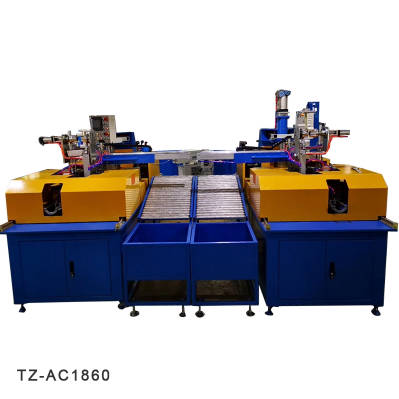
What is Air Coiling (Free-Form Coiling)?
Air coiling, also known as free-form coiling or flyer coiling, is a method where a cable or wire is wound into a coil without a central forming core. It relies on the controlled motion of a rotating arm or capstan to lay the cable into a collection basket fitted with pins. The resulting coil is functional and produced at high speed, though it typically has a characteristic "figure-8" or slightly ovular shape rather than being perfectly round.
The Mechanics of Air Coiling
In an air coiling machine, the process begins with the cable being fed through a guiding system and a length counter. A high-speed rotating "flyer arm" then takes the cable and wraps it into a circular path. The cable falls into a coiling head or basket, which is typically equipped with a series of retractable pins. These pins support the forming coil and define its inner and outer diameters. Once the pre-set length of cable has been coiled, the machine stops, the pins retract, and the finished coil is ejected, often onto a conveyor for subsequent processing like automatic strapping or packaging. The entire cycle is extremely fast because there are no complex mechanical parts like a collapsible core to actuate.
Key Advantages of Air Coiling
The primary benefit of air coiling is its exceptional speed. By eliminating the mechanical step of engaging and disengaging a mandrel, cycle times are significantly reduced, making it the superior choice for high-volume production lines. These machines are also generally less complex mechanically, which often translates to a lower initial investment (CAPEX) and potentially simpler maintenance. Air coilers offer great versatility for small to medium-diameter flexible cables, such as building wire, telecommunication cables (e.g., Cat5e, Cat6), and automotive wiring, allowing for quick changeovers between different product lengths.
Limitations and Disadvantages of Air Coiling
The main drawback of air coiling lies in the coil quality and its limitations with certain cable types. The coils are not perfectly round, which can be an issue for specific packaging requirements or end-user presentation standards. More importantly, this method is not suitable for large, heavy, or stiff cables. The lack of a central core makes it difficult to control the winding of rigid cables, which can spring back and create a messy, unstable coil. The weight of heavy power cables can also be too much for a pin-based system to support, leading to coil collapse and handling issues.
What is Mandrel Coiling (Core Winding)?
Mandrel coiling, often called core winding, is a precision-focused method that involves winding the cable around a physical, cylindrical core known as a mandrel. This process guarantees a perfectly round, tightly wound coil, making it the industry standard for applications where coil shape, density, and stability are critical.
The Mechanics of Mandrel Coiling
In a mandrel coiling machine, the process starts with the leading end of the cable being clamped to the mandrel. The mandrel then rotates, pulling the cable and winding it onto its surface in precise layers. The movement is often synchronized with a traversing guide that ensures the cable is laid neatly side-by-side. Once the target length is reached, the cable is cut. The key mechanical feature is the mandrel itself, which is typically a collapsible design. After winding, the segments of the mandrel retract inward, reducing its diameter and allowing the perfectly formed coil to be easily and automatically stripped off. This collapsing action is crucial for removing the dense coil without damaging it.
Key Advantages of Mandrel Coiling
The undisputed advantage of mandrel coiling is superior coil quality. It produces dense, stable, and perfectly round coils every time. This makes it essential for automated packaging systems that require consistent coil dimensions. Mandrel coiling is the go-to solution for heavy, stiff, and large-diameter cables, including industrial power cables, armored cables, and hydraulic hoses. The solid core provides the necessary support and control to handle the inherent memory and rigidity of these materials, preventing spring-back and ensuring a tight, secure wind. The resulting coils are easier to handle, stack, and package, improving downstream efficiency.
Limitations and Disadvantages of Mandrel Coiling
The precision of mandrel coiling comes at the cost of speed. The cycle time is inherently longer due to the mechanical steps of clamping the cable, collapsing the mandrel, and stripping the coil. This makes it less suitable for applications demanding the highest possible output in units per hour. Furthermore, mandrel coiling machines are more complex mechanically, which leads to a higher initial purchase price and potentially more intensive maintenance requirements. Changing the inner diameter of the coil also requires a tooling change—swapping out the mandrel—which can add to changeover time compared to the more easily adjustable pin systems on some air coilers.
Head-to-Head Comparison: Air Coiling vs. Mandrel Coiling
To simplify the choice, it's helpful to see a direct comparison of the two technologies across several key performance indicators. The following table summarizes the primary differences between air coiling and mandrel coiling.
| Feature | Air Coiling | Mandrel Coiling |
|---|---|---|
| Coil Quality & Shape | Good; "figure-8" or eye-shaped coil. Not perfectly round. | Excellent; perfectly round, dense, and stable coil. |
| Ideal Cable Types | Small to medium diameter, flexible cables (building wire, data cables, automotive wire). | Large diameter, stiff, rigid, or heavy cables (power cables, armored cables, hoses). |
| Production Speed | Very High. Minimal mechanical movements lead to short cycle times. | Moderate. Slower cycle times due to mandrel actuation and coil stripping. |
| Machine Cost (CAPEX) | Generally lower due to simpler mechanical design. | Generally higher due to the complexity of the collapsible mandrel system. |
| Versatility & Changeover | Often easier to adjust for different coil lengths and diameters (within a range). | May require tooling (mandrel) changes to alter the coil's inner diameter. |
| Typical Applications | High-volume consumer and commercial wiring, telecommunications. | Industrial, utility, and heavy-duty applications; premium retail packaging. |
Which Coiling Machine Should You Choose? A Decision-Making Guide
The choice between an air coiler and a mandrel coiler is not about which is "better," but which is right for your specific product and process. By asking the following questions, you can systematically determine the best fit for your operation.
What are your cable's core characteristics?
This is the most critical factor. Start by analyzing your product. Is your cable flexible and lightweight, with a diameter under 25mm (1 inch)? If so, an air coiler is likely a strong candidate, offering the speed you need for efficient production. However, if you are producing large-gauge power cables, armored cables, or semi-rigid coaxial cables, their stiffness and weight demand the control and support that only a mandrel coiler can provide. Winding a stiff cable without a core will result in an uncontrollable, springy coil that is a safety and handling hazard.
What are your production volume and speed requirements?
Evaluate your production targets. Are you in a market that requires producing thousands of coils per shift? For products like standard building wire sold in retail, production speed is paramount. The fast cycle times of an air coiling machine are designed for this high-volume environment. Conversely, if your product is a specialized industrial cable sold in lower quantities where precision and quality are the main selling points, the slower, more deliberate process of a mandrel coiler is a justifiable trade-off for a superior final product.
What are your packaging and end-user requirements?
Consider the destination of your coil. Does it need to fit into a specific box or dispenser pack that requires a perfectly round shape? Are your customers in a premium market where the appearance of the coil reflects the quality of the product within? If the answer is yes, a mandrel coiler is non-negotiable. The perfect coils it produces are ideal for automated boxing and shrink-wrapping, and they present a more professional appearance. If your coils are simply a means of transport before being installed, and a functional "figure-8" coil is acceptable, then an air coiler is a cost-effective solution.
What is your budget and operational capacity?
Finally, assess your financial and operational constraints. Air coilers typically have a lower initial cost, making them more accessible for businesses with a limited capital budget. Their simpler design may also lead to lower long-term maintenance costs (OPEX). A mandrel coiler represents a larger upfront investment due to its greater mechanical complexity. You must weigh this higher cost against the value it provides in terms of quality, capability with heavy cables, and downstream packaging efficiency. Also, consider the skill level of your operators and maintenance staff when evaluating machine complexity.
Beyond the Basics: Modern Features in Cable Coiling Technology
Regardless of the coiling method, modern machines incorporate advanced features that enhance productivity, safety, and quality. When evaluating suppliers, look for these value-added technologies.
Automation and PLC Control
Today's leading cable coiling machines are controlled by Programmable Logic Controllers (PLCs) and operated via intuitive Human-Machine Interfaces (HMIs). This allows for precise control over every parameter, including coiling speed, tension, length accuracy, and traversing pitch. Operators can save "recipes" for different products, enabling fast and repeatable changeovers with the touch of a button. This level of automation reduces human error and ensures consistent quality from the first coil to the last.
Integrated Strapping and Wrapping
To create a fully automated "line-to-pallet" solution, many coiling machines can be integrated with automatic binding systems. After the coil is formed and ejected, it is transported to a strapping or stretch-wrapping station that automatically secures the coil. This eliminates a highly repetitive and labor-intensive manual task, freeing up operators for more value-added work, improving line throughput, and ensuring every coil is securely bound for transport.
Safety and Ergonomics
Modern equipment design prioritizes operator safety. Look for features like fully enclosed safety guarding with interlocked doors, light curtains that stop the machine if an operator enters a hazardous area, and emergency stop circuits. Ergonomics are also key, with features like automatic coil ejection at a comfortable working height to reduce bending and lifting, minimizing the risk of musculoskeletal injuries for operators.
Conclusion: Making the Right Choice for Your Production Line
The debate of Air Coiling vs. Mandrel Coiling is settled not by declaring one universally superior, but by aligning the technology with the application. Air coiling is the undisputed champion of speed and cost-efficiency for flexible, small-diameter wires where a perfect coil shape is secondary. In contrast, mandrel coiling is the essential tool for precision, quality, and control, providing the robust solution needed for heavy, stiff, and large-diameter cables that demand a perfect, stable coil.
By carefully evaluating your product specifications, production goals, packaging needs, and budget, you can confidently select the cable coiling machine that will serve as a reliable and profitable asset for your manufacturing operation. For the best outcome, engage with experienced equipment manufacturers who can provide expert guidance and tailor a solution to your unique requirements.